
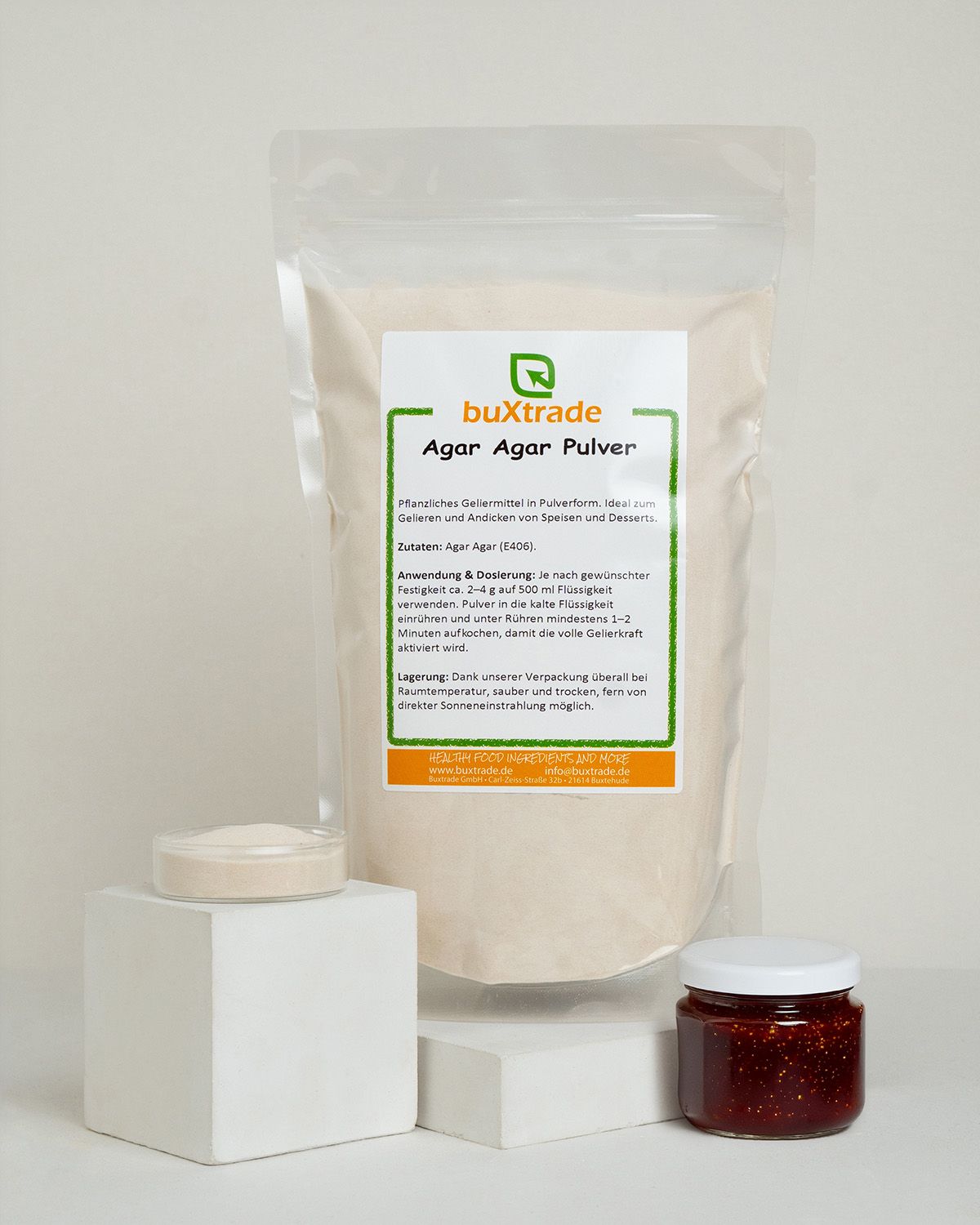


Agar agar powder vegan gelatine
Quantity
In stock -


Many products also in organic quality

Certified/tested products

Flexible packaging sizes

Diverse range
| Brennwert: | 774 kJ / 193 kcal |
| Fett: | 0,30 g |
| davon gesättigte Fettsäuren: | 0,00 g |
| davon ungesättigte Fettsäuren: | 0,00 g |
| Kohlenhydrate: | 3,00 g |
| davon Zucker: | 0,00 g |
| Ballaststoffe: | 88,10 g |
| Eiweiß: | 0,40 g |
| Salz: | 0,10 g |
Store your buxtrade product dry, clean and at room temperature. Avoid direct sunlight. Close the bag carefully after opening - this way, freshness and quality are optimally preserved.
The product images are for illustrative purposes only. For a better overview, some of the products are shown in transparent bags that do not correspond to the actual packaging. The delivered goods may therefore differ in their presentation. Batch-related differences are also possible.
Deliveries within Germany with DHL Express: Delivery within 1-2 working days for orders placed before 13:30.
Deliveries within Germany with DHL Standard shipping.
Returns: Returns possible within 14 days of receipt - see Return conditions
buxtrade GmbH
Carl-Zeiss-Str. 32b
21614 Buxtehude
Tel.: 04161 66955 0
Responsible person:
Julian Meyer
Carl-Zeiss-Str. 32b
21614 Buxtehude
Tel.: 04161 66955 0
Mail: shop@buxtrade.de
Buy Agar-Agar Powder – the Plant-Based Gelling Agent from the Sea
Agar-agar is one of the oldest plant-based gelling agents in the world—extracted from red algae and refined into a fine, flavorless powder. What has been a staple of Asian cuisine for centuries has long since conquered the vegan culinary scene in Europe as well: Agar-agar sets reliably, thickens precisely, and imparts no flavor of its own—whether in desserts, sauces, or savory dishes.
Agar-agar stands out above all for its efficiency: even a 1% concentration in hot water is enough to produce a stable, elastic gel. Half a teaspoon replaces four sheets of gelatin—and it’s made entirely from plant-based ingredients, with no animal-derived components.
The key difference from gelatin: Agar-agar remains stable even when heated and sets at room temperature. To use it, stir the powder into a liquid and bring it to a brief boil. After that, it does the rest on its own.
Whether it's vegan panna cotta, homemade fruit jelly, thickened sauce, or a culture medium in the lab—agar-agar is more versatile than many people realize.
More information about our agar-agar powder
Ingredients: 100% agar-agar, made from Gracilaria (E406).
Usage & Dosage:Depending on the desired consistency, use approximately 2–4 g per 500 ml of liquid. Stir the powder into the cold liquid and bring to a boil while stirring for at least 1–2 minutes to activate the full gelling power.
Buy Agar-Agar Powder – The Vegan Gelling Agent for the Kitchen, Lab, and More
Plant-based gelling, precise binding, perfect thickening—agar-agar powder makes it all possible, without animal-derived ingredients and without compromise. Agar-agar is used in a wide range of applications, from vegan cuisine to food processing and even science. What’s behind this gelling agent made from seaweed, how does it work, and why is it worth buying agar-agar powder instead of relying on alternatives? You’ll find the answers here.
What is agar-agar, and what is it made of?
Agar-agar is derived from red algae, primarily of the genera Gracilaria and Gelidium. The algae are harvested, dried, and processed into a fine, whitish powder. Chemically speaking, they are polysaccharides—plant-based carbohydrate chains that swell in hot water and form a solid gel as they cool.
In the EU, agar-agar is approved as a food additive under the code E 406 and is used as a gelling agent, thickener, and stabilizer—in soups, confectionery, ice cream, and much more. This substance has a long tradition dating back to 17th-century Asian cuisine. It was originally discovered in Japan.
Agar-Agar Flakes or Powder: The Differences
Both forms are made from the same base material, but they behave differently when used. Agar-agar flakes have a coarser texture, dissolve more slowly, and require a greater volume to achieve the same gelling strength. As a rule of thumb: To achieve the same effect as one teaspoon of agar-agar powder, you’ll need about three teaspoons of flakes.
Agar-agar powder, on the other hand, dissolves more evenly, can be measured more precisely, and blends more seamlessly into liquids. For precise results—whether in the kitchen or in the lab—it’s the more reliable choice. Flakes are a good option when a rough measurement is sufficient and the longer dissolving time isn’t an issue.
Using Agar-Agar Powder: Here's How to Dissolve It Properly
The crucial step in any recipe using agar-agar powder: The powder must be brought to a boil. Without brief, vigorous heating, the gelling effect will not occur—this is the most common mistake leading to failed gels.
Here's how to do it: Stir the agar-agar powder into cold or lukewarm liquid, then bring it to a boil while stirring constantly. Let it boil briefly, then remove it from the heat. The gel will form as it cools, even at room temperature; a refrigerator isn't absolutely necessary.
Why won't my agar-agar jelly set?
In addition to insufficient heating, there is a second common reason: highly acidic ingredients such as fresh pineapple, kiwi, or mango contain enzymes and acids that can reduce the gelling power. To remedy this, you can either use a slightly larger amount of powder or heat the fruit beforehand.
Agar-agar as a substitute for pectin in jam
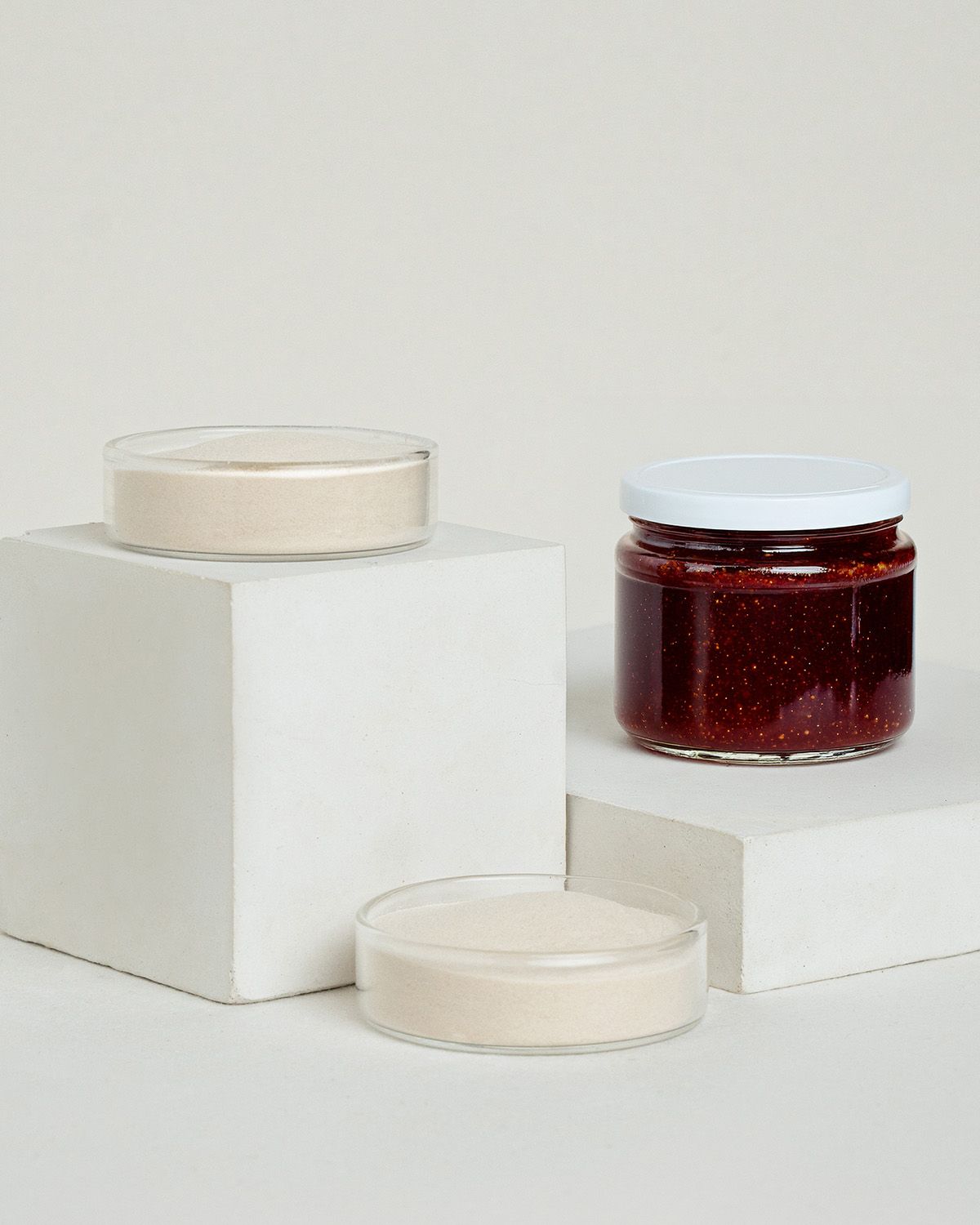
Pectin is the standard gelling agent for jams—but it’s not the only one. Agar-agar works well as an alternative, especially for fruits with low natural pectin content, such as strawberries, cherries, or peaches.
The result differs in texture: Agar-agar produces a firmer, more solid jelly that retains its shape even at room temperature. If you prefer a classic, spreadable jam, you should reduce the amount and experiment with the consistency. For jelly varieties like quince jelly, which are meant to be served as individual slices, agar-agar is ideal.
The Use of Agar-Agar in Microbiology and Plant Tissue Culture
When people think of agar-agar, they usually think of cooking—but it’s just as indispensable in biology. In microbiology, it serves as a culture medium in Petri dishes: It forms a stable, solid surface on which bacteria and fungi can be cultured under laboratory conditions.
The key advantage over gelatin: Gelatin melts at body temperature—that is, precisely at the 35–37 °C at which many bacterial cultures are incubated in an incubator. Agar-agar, on the other hand, only liquefies at around 85 °C and thus remains reliably solid even at incubation temperature. Furthermore, most microorganisms do not break down agar-agar as a nutrient—the culture medium remains stable throughout the entire experimental period.
In plant tissue culture, it serves a different purpose: As an inert support medium, it holds nutrient solutions in which plant cells grow and develop. The chemical neutrality of the substance is particularly crucial here. Agar-agar does not react with the embedded nutrients and does not affect cell growth.

About Us
We have been offering high-quality products for sports, health, and well-being since 2014. What began as a side business just outside Hamburg quickly developed into a successful company with a wide range of products at fair prices.

Production
In our broad product portfolio in the areas of sugar substitutes, superfoods, food additives, dietary supplements, spices, dried fruits & nuts We offer all products, depending on your needs, from private households to food processing, from 100g to wholesale quantities in pallets. In Buxtehude, just outside Hamburg, all products are carefully filled by hand into resealable stand-up pouches.

With our newsletter, you'll regularly receive updates on our products. We won't overload your inbox and we'll keep you up to date with special offers.